
Lock Repair and Replacement
A lock that sticks, wobbles or stops its bolt short is telling you which part is wearing. Some of that trouble comes out with a screwdriver and a strike adjustment; some of it means the lock has reached the end of its life and a new one goes in.
Signs a Lock Needs Repair or Replacing
- The key turns stiffly, or only when you force it.
- The lock feels loose on the door or wobbles when you turn it.
- The deadbolt stops short and does not fully extend.
- The door will not latch when you close it.
- The lock was damaged in a break-in attempt.
- The hardware is old, worn through or pitted.
The Worn Part Decides the Job
Lock trouble starts in a few places: the screws and trim that hold the lock to the door, the pins inside the cylinder, the bolt and its strike, or the spring behind the latch. When the fault is an adjustment or a small worn part, a repair brings the lock back. When the fault is inside a sealed mechanism, or the lock body is cracked or bent, replacement is the sounder choice. If a lock can be repaired instead of replaced, Fernando Gonzalez, who runs the shop, will tell you so.
Each of these faults has its own early signs and symptoms, and catching them early often keeps the job on the repair side.
| What you notice | Usually repairable | Usually needs replacing | Why |
|---|---|---|---|
| Loose trim or a lock that wobbles | The mounting screws have backed out; tightened or swapped for new ones, they pull the lock snug again. | The threaded posts the screws run into have stripped or snapped off. | Every turn works the screws a little; once the threads are gone, a screw has nothing to bite. |
| A key that turns stiffly | Grit in the keyway or a key worn round; a cleaned cylinder or a key cut fresh to the lock fixes it. | The plug and its pins are worn, so even a new key drags or catches. | The pins ride the cuts of the key; dirt or a rounded key keeps them from lining up at the shear line. |
| A deadbolt that will not fully extend | The strike is out of line, the door has sagged, or the bolt hole in the frame is too shallow. | The bolt mechanism has broken, so the bolt stops short even with the door open. | A bolt that throws fully with the door open but not when it is closed points to the door or the strike; one that stops short either way points to the lock. |
| A door that will not latch | The latch meets the strike plate high or low; moving the strike or filing its opening lets it catch. | The latch spring has broken, so the latch stays in or will not spring back out. | The latch needs its spring to snap into the opening; a shifted door makes it hit metal instead. |
| Damage after a break-in attempt | Rarely: only a bent strike or split trim, with a lock that still turns smoothly. | A torn shell, a chewed cylinder or a bent bolt, which is the usual result. | Forced entry bends the parts that keep the pins in line, so a lock can look whole and still fail. |
| Old, worn hardware | A solid old lock with a tired finish can be cleaned, tightened and given new pins. | Finish worn through to bare metal, pitted parts or play inside the lock body. | Age alone is no reason to replace a lock; wear in the moving parts is. |
Forced Entry Leaves a Lock Weaker Than It Looks
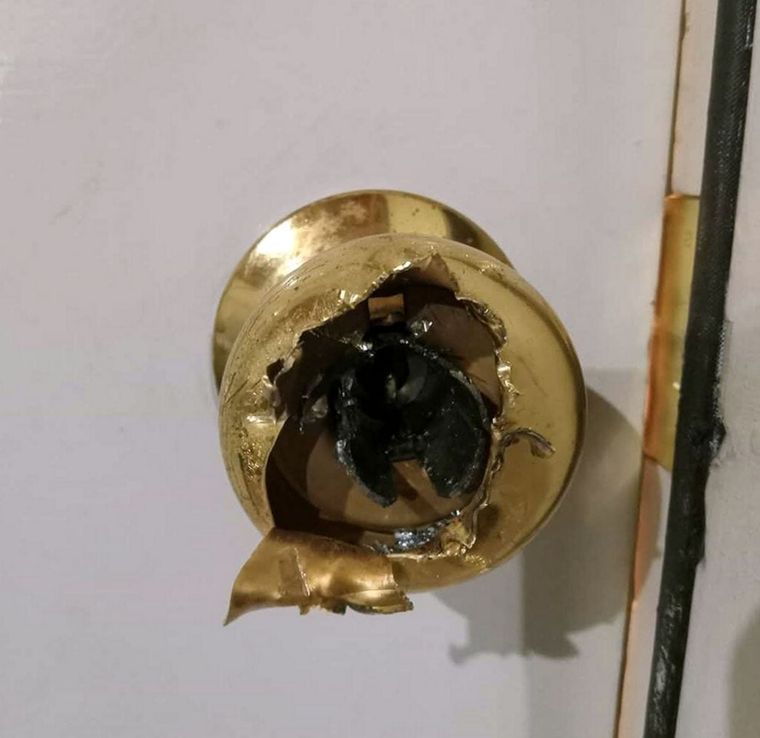
A knob lock takes the worst of a break-in attempt. Someone trying to get in twists the knob with a wrench, pries the outer shell off or drives a tool into the keyway, and the brass shell, the plug and the pins give way. Even when the knob still turns afterward, the pins and springs inside may be bent, and the lock may no longer hold the door.
A knob lock alone is a weak lock for an outside door. Its latch is short and spring-loaded, with a slanted face so the door can close on it, and that same slant lets a thin tool push it back. The force of a kick goes into that short latch and the thin strip of wood around it.
That is why an outside door wants a deadbolt beside its knob or handle set. A deadbolt throws a solid bolt about an inch into the frame, and nothing at the door edge can push it back. With a reinforced strike plate held by long screws that reach the wall framing behind the jamb, a kick has to fight the framing, not a strip of trim.
After an attempt, look past the lock itself. The jamb around the strike, the hinges and the door edge can split even when the lock still works, and a key taken in the attempt is a good reason to think about rekeying the other doors.
Locks You Will Find on an Entry Door
Most house doors carry some mix of four kinds of lock, and each fails in its own way.
- Knob lock. A round knob with the keyway in its center and a spring latch; fine on a bedroom or a closet, weak as the only lock on an outside door.
- Deadbolt. A solid bolt moved by a key outside and a thumb turn inside, with no spring behind it; the lock that actually secures an outside door.
- Handle set. A grip handle with a thumb latch outside and a knob or lever inside, usually fitted with a matching deadbolt over it.
- Smart lock. A deadbolt worked by a keypad, a phone or both, most often with a keyed cylinder kept as a backup.
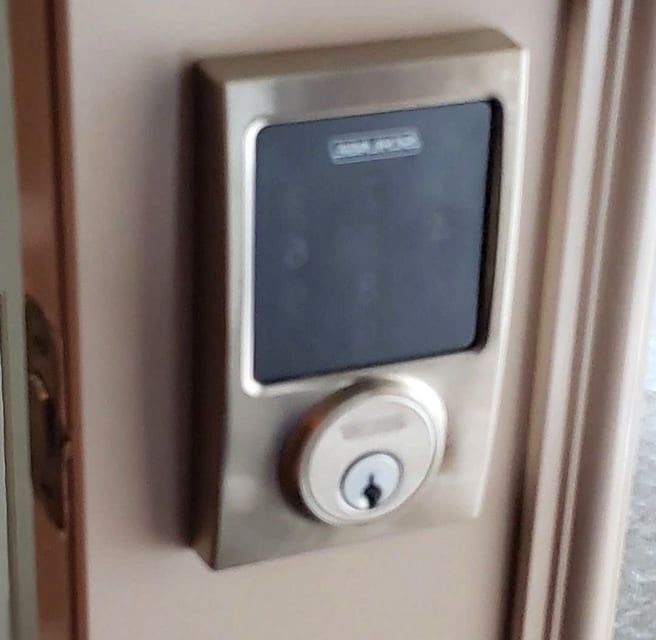
A front door usually has two locks doing two jobs. The handle set keeps the door shut with its latch, and the deadbolt over it locks the door. A keypad deadbolt on a handle set keeps that split: the keypad and the keyed cylinder both work one bolt, and the handle set still does the latching.
When a smart lock starts to miss, the cause is often mechanical, not electronic. A bolt that rubs on a strike set a little out of line makes the motor strain, stall and drain its batteries early. Setting the strike right fixes the lock and the battery life together, and it is a far smaller job than a new lock.
Fitting a Deadbolt Into Door and Frame
Springwells Locksmith installs deadbolts on doors that have none and on doors where the old one has given out. On a door with no deadbolt, the work starts with two holes. The face bore goes through the face of the door for the cylinder and the thumb turn, usually 2-1/8 inches across. The edge bore runs from the edge of the door into that hole for the bolt, usually 1 inch across. The distance from the door edge to the center of the face bore is the backset, 2-3/8 or 2-3/4 inches on most house doors, and the bolt has to match it.
Then the frame side. The bolt hole in the jamb is drilled deep enough for a full throw, the strike plate is set flush into the jamb, and long screws, often 3 inches, pass through the jamb into the stud behind it. A deadbolt is fitted right when it throws and pulls back all the way with the door closed, with no lift or shove on the door, from the key and the thumb turn alike.
Older doors add their own work. Front doors on older Detroit houses often carry holes from two or three earlier locks, so a new deadbolt goes where it misses them, or the old holes are filled and covered with a reinforcing plate.
Questions About Choosing a New Lock
What do the grades on a lock package mean?
They come from a standard written by ANSI and BHMA, the hardware makers’ association, which rates a lock on how many cycles it survives and how much force it resists. Grade 1 is the heaviest, built for busy commercial doors; Grade 2 is a sound choice for most house doors; Grade 3 is the lightest. A grade rates the lock body, so it does not make up for a strike held by short screws.
Will a new lock fit the holes in my door?
Usually, if it matches the backset, the door thickness and the face bore already in the door. Most residential locks fit doors from 1-3/8 to 1-3/4 inches thick, and many new latches adjust between the two common backsets. A door drilled for an old lock of another size, or one with a mortise lock in a pocket in its edge, may need a different lock or some work on the door first.
Can a new lock work with the same key as my other doors?
Yes, as long as the new lock takes the same keyway as the others. The new cylinder is pinned to the key you already use, so one key still opens every door. When the brands differ, the usual answer is a lock of the matching brand, or rekeying the other locks to match the new one.
Is a smart lock a good choice for a front door?
It can be. Choose one that keeps a keyed cylinder, so a key still opens the door when the batteries give out. Underneath the keypad, a smart lock is still a deadbolt: it needs the same backset, the same full throw and the same solid strike as any other.
Start With a Description of the Lock
Say which door it is, where the lock catches or slips, and how long it has been that way. Call (313) 254-3267 or schedule an estimate with a few lines about the lock.